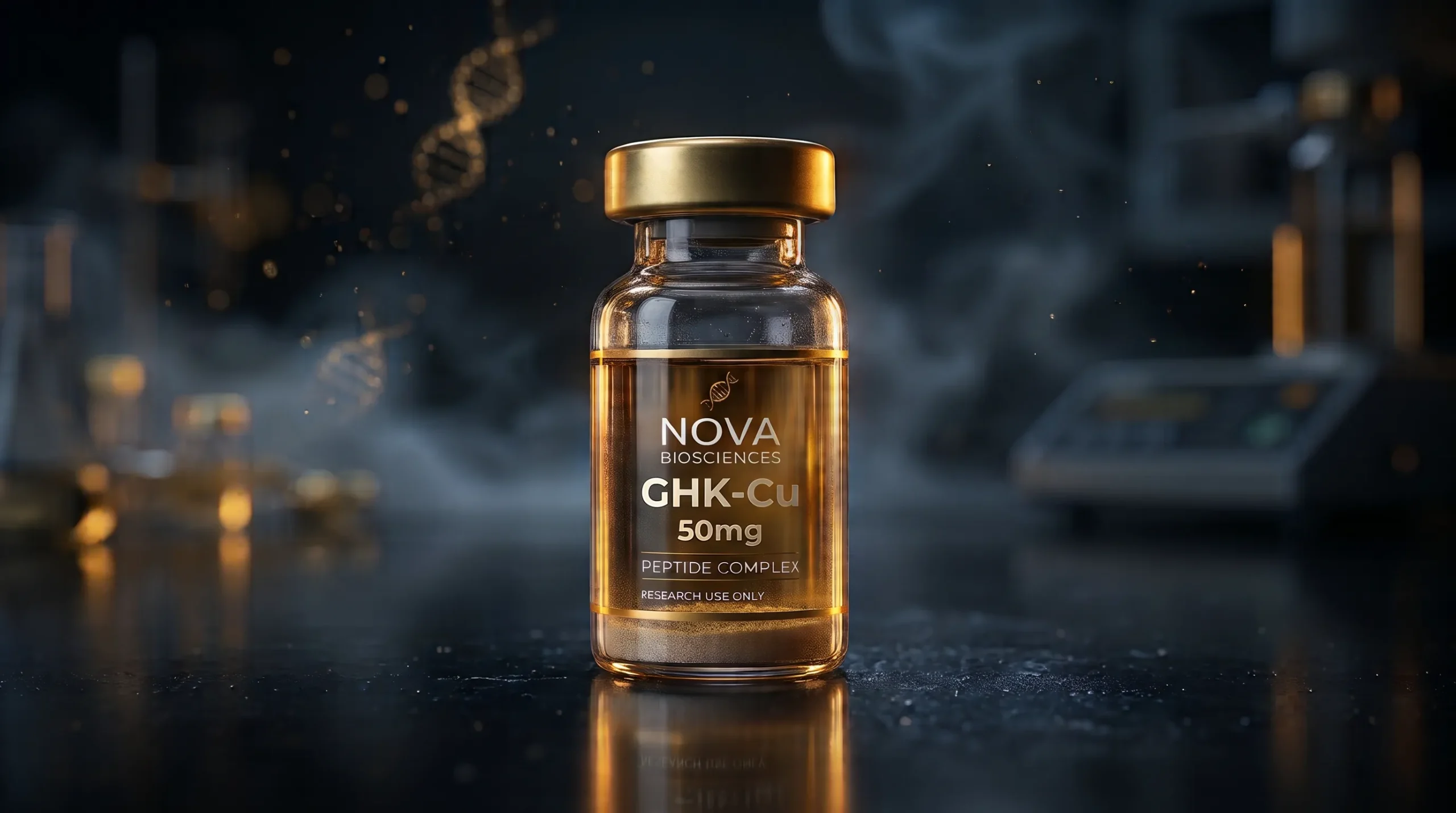
GHK-Cu is a small copper-binding peptide that researchers have studied for decades, and it remains a frequent subject of laboratory work on skin, tissue repair and gene expression. Its full name — glycyl-histidyl-lysine bound to copper — describes a three-amino-acid sequence that can carry a copper ion, which is central to how it behaves in experimental models. Nova BioSciences supplies GHK-Cu 50mg for laboratory research, and this article gives an educational overview of the research. It is about laboratory science, not about any use outside the laboratory.
What Is GHK-Cu?
GHK-Cu occurs naturally in human plasma, saliva and urine, and its levels are highest in young people and decline with age. In the laboratory, it is studied as a model for how copper is delivered to cells and how that delivery affects enzyme activity. Copper is a cofactor for several enzymes involved in building connective tissue, in antioxidant defence and in the production of energy, so a peptide that can bind and release copper in a controlled way is a useful research tool. GHK-Cu is typically supplied as a lyophilised powder, reconstituted only for in vitro experiments, and handled like any other analytical-grade peptide.
GHK-Cu in Skin and Tissue Research
Much of the research on GHK-Cu has focused on skin and on the repair of connective tissue. Laboratory studies look at how it affects fibroblasts, the cells that produce collagen and other structural proteins, and at whether it changes the expression of genes involved in remodelling tissue after injury. Other studies examine its antioxidant behaviour in cell models, asking whether the copper it carries helps neutralise reactive molecules that can damage cells. Researchers also study its role in wound models, where they measure markers of new blood vessel formation and of the orderly deposition of collagen — both important for how tissue regains strength during repair.
GHK-Cu and Gene-Expression Research
One of the more discussed aspects of GHK-Cu research is its apparent effect on gene expression. Studies using gene arrays have reported that the peptide can shift the activity of groups of genes linked to repair, inflammation and tissue remodelling, and in some models it appears to reverse some of the gene-expression changes associated with ageing. These findings are intriguing, but they come with caveats: gene-expression changes in a cell culture model are a long way from a proven effect in a living organism, and the results depend heavily on the model, the dose and the time frame studied. Researchers treat this part of the literature as a source of hypotheses, not as settled fact.
Laboratory Handling
For laboratory work, GHK-Cu is stored according to the supplier’s guidance, protected from light, heat and moisture, and used within the period covered by the lot documentation. Because it contains copper, it should be handled with the same care as any metal-containing reagent, and waste should be disposed of following laboratory protocols. As with other research peptides, the lot number, reconstitution solvent and concentrations used should be recorded in full, so that experiments can be repeated and compared between laboratories.
What the Evidence Does Not Show
It is important to be clear: the evidence for GHK-Cu comes mainly from cell and animal studies, and there are no large, well-controlled human trials that establish its effects. Many of the claims that circulate about this peptide come from summaries of the research that go well beyond what the studies actually show. For a careful reader — and for the laboratories that use it — the value of GHK-Cu is as a research compound for studying copper biology, tissue repair and gene regulation in controlled settings.
For laboratory research only. Not for human consumption.