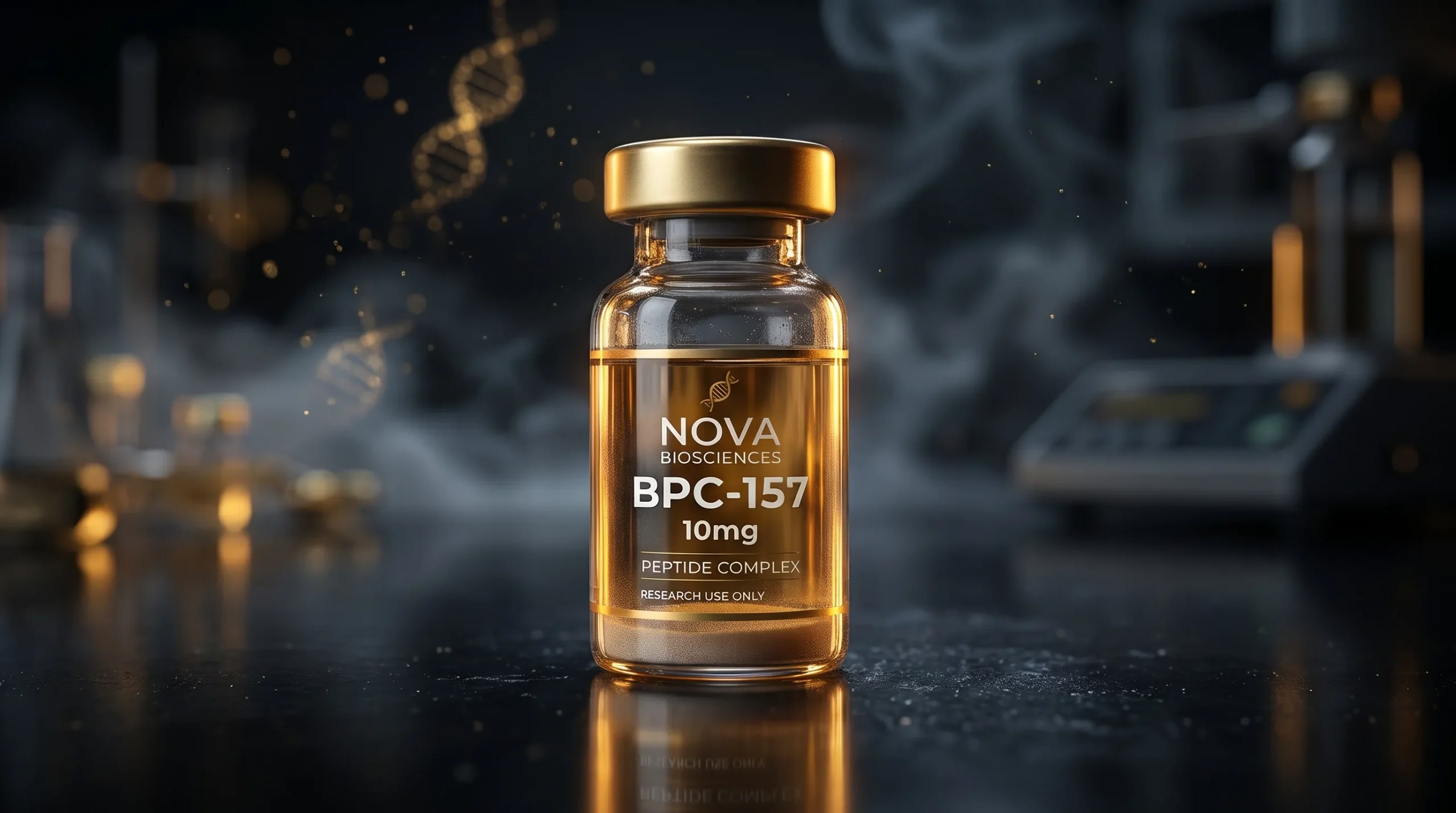
BPC-157 is one of the most discussed compounds in laboratory peptide research. Short for Body Protection Compound-157, it is a synthetic pentadecapeptide made up of 15 amino acids. In research settings, it is studied as a model compound for understanding tissue repair, cellular signalling and mucosal biology. Nova BioSciences supplies BPC-157 (10mg) for laboratory research, and this article gives an educational overview of what researchers are studying — not guidance for any use outside the laboratory.
What Is BPC-157?
BPC-157 is a partial sequence of a protein found in human gastric juice, known as Body Protection Compound. Researchers first became interested in it because of its stability in biological fluids and its apparent interaction with several growth-related pathways. In the laboratory, it is typically supplied as a lyophilised powder in a sealed vial, which is reconstituted only for in vitro work. Because it is a research compound, every batch used in a study should be traceable to its lot number and its Certificate of Analysis, so results can be compared across experiments and between laboratories.
What Researchers Are Studying
Much of the published research on BPC-157 focuses on tissue repair models. Laboratory studies have examined how the peptide behaves in models of tendon, ligament and muscle tissue, where researchers look at markers of cell migration, collagen organisation and new blood vessel formation. Other studies have looked at the gastrointestinal tract, investigating how the compound interacts with mucosal cells and with signalling pathways linked to gut lining integrity. A third area of interest is the nervous system, where researchers study its effects on cellular models of nerve injury and on the interaction between the gut and the brain in animal models.
None of this work establishes an effect in people. The evidence base is largely preclinical, built from cell culture and animal studies, and the results vary between models, doses and experimental designs. That variability is itself one of the reasons researchers keep studying the compound: it raises questions about mechanism, dose response and reproducibility that only further controlled laboratory work can answer.
How Laboratories Handle BPC-157 in Research
In a research setting, BPC-157 is handled like any other analytical-grade peptide. It is stored according to the supplier’s guidance, protected from light and heat, and used within the period covered by the lot’s documentation. Researchers record the lot number, the reconstitution solvent and the concentrations used, because those details affect whether an experiment can be repeated. Good laboratory practice also means keeping the compound separate from any material intended for other purposes and labelling everything clearly as a research chemical.
What the Literature Does and Does Not Say
The literature on BPC-157 is growing, but it has limits that readers should keep in mind. Many studies are small, use different models, and have not been replicated independently. Systematic reviews of the field consistently note the lack of large, well-controlled human trials, and they describe the compound as experimental. For researchers, that means the literature is useful for generating hypotheses and designing experiments, but it is not a basis for conclusions about human health — and it should not be presented that way.
Research-Only Reminder
BPC-157 is supplied by Nova BioSciences strictly for laboratory research. It is not a medicine, a supplement or a food, and it is not intended for human or animal consumption. Anyone reading research about this compound should treat it as science in progress, not as advice.
For laboratory research only. Not for human consumption.