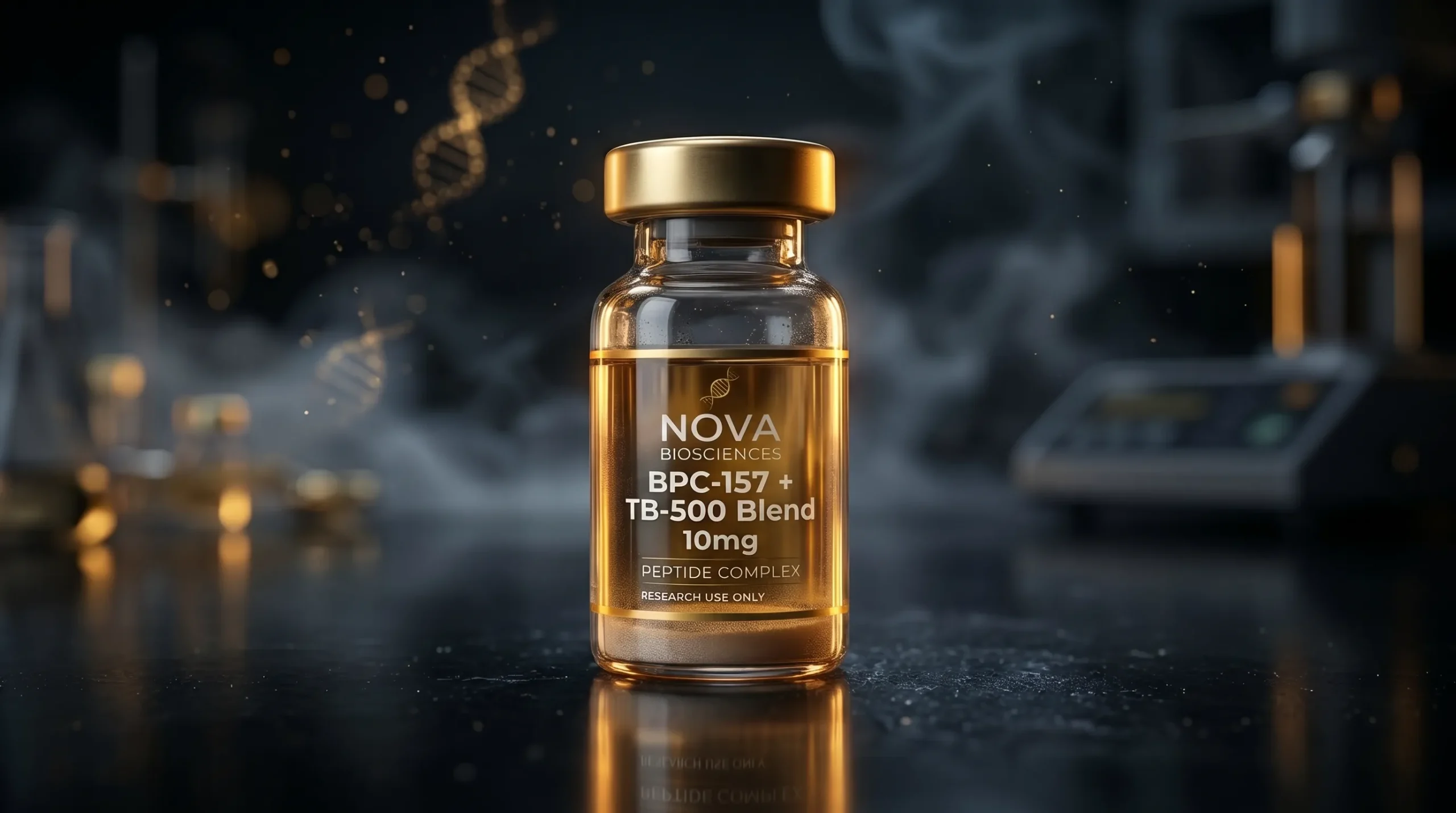
Research teams often study compounds in combination, and one pairing that appears regularly in the laboratory literature is TB-500 with BPC-157. TB-500 is a synthetic version of thymosin beta-4, a naturally occurring peptide involved in cell movement and repair, while BPC-157 is a synthetic pentadecapeptide studied in tissue repair models. Nova BioSciences supplies a BPC-157 + TB-500 Blend (10mg) for laboratory research, and this article looks at what the literature actually discusses when these two compounds are studied together — as science, not as guidance for any use outside the laboratory.
What Are TB-500 and BPC-157?
Thymosin beta-4 is a protein found in most cells, where it helps regulate actin, the structural protein that lets cells move and change shape. TB-500 is a synthetic fragment of that protein, designed for research into wound healing and tissue regeneration. BPC-157, meanwhile, is derived from a sequence found in gastric juice and is studied for its interaction with growth-related pathways and mucosal biology. On their own, each compound has a separate research history; together, they are studied because their proposed mechanisms appear complementary — one acting on the cell’s structural machinery, the other on signalling pathways linked to repair.
Why Researchers Combine Them
The idea behind studying a blend is that repair in living tissue is not a single process. It involves inflammation, cell migration, the formation of new blood vessels, collagen production and tissue remodelling, all happening in sequence. Researchers who study blends ask whether two compounds that act on different parts of that sequence produce a larger or faster response together than either does alone. In practical terms, a blend also simplifies an experiment: instead of preparing and dosing two separate compounds, a laboratory can work with one defined mixture, with fixed proportions, and compare it directly against each compound on its own. That design makes it easier to tell whether any difference is due to the combination itself.
What the Literature Discusses
The published literature on this combination is smaller than the literature on either compound alone, and it is mostly preclinical — cell culture and animal models. Studies of TB-500 on its own report effects on cell migration and on markers of angiogenesis, the formation of new blood vessels, in wound models. Studies of BPC-157 report effects on tendon, muscle and gut tissue models. When the two are discussed together, the literature tends to focus on recovery models: how quickly tissue markers return to baseline, how collagen is organised during repair, and whether the combination changes outcomes compared with single-compound controls. The results are described as promising but preliminary, and reviewers note that the studies are small, use different models, and often lack independent replication.
Study Design Considerations
For a laboratory studying a blend, design matters more than usual. The ratio of the two compounds, the total dose, the timing of administration and the choice of model all affect the results, so these details need to be recorded precisely and reported in full. Controls are essential: a well-designed study compares the blend against each compound alone and against a vehicle control, so any difference can be attributed to the combination. Lot traceability is also important here, because a blend has two active components — each should be traceable to its own lot and Certificate of Analysis, and the blend itself should carry a single lot number that links to both.
What This Does Not Mean
It is worth stating plainly: there are no large, well-controlled human trials of this blend, and the preclinical evidence does not support conclusions about effects in people. The blend is a research tool for studying how two repair-related compounds behave together in controlled models. Presenting it as anything more than that would misrepresent the science.
For laboratory research only. Not for human consumption.